Key Takeaways:
- Subscription apps generated $79.5 billion in revenue in 2025, with Health & Fitness apps leading at $0.44 median revenue per install (RevenueCat, 2025)
- Creators with subscription-based revenue models average $94,731 in annual earnings vs. $67,196 for mixed-model creators (Whop, 2026)
- The top 5% of subscription apps earn 400x more than the bottom 25% after year one—the difference is product-market fit, not luck
- You don't need millions of followers. 200-500 subscribers at $30-50/month gets you to $10K+ MRR
- This 6-step framework takes you from "I have a following" to "I have a product business" in 90 days or less
You post content every day. You've built an audience. People trust your advice.
But here's what nobody tells you: content alone doesn't build a business. It builds someone else's business—the platform's.
What is a subscription app? A subscription app is a mobile application where users pay a recurring fee (monthly or yearly) for ongoing access to your content, tools, or services. Unlike selling a course once for $99, a subscription app at $9.99/month earns you $120/year per user—and that compounds every month.
The creator economy hit $203.6 billion in 2026, according to Grand View Research. But most of that money goes to platforms and brands, not creators. Only 4% of creators earn over $100K/year. Subscription apps flip that equation.
Here's the exact 6-step framework to turn your expertise into a subscription app that generates recurring revenue.
Step 1: Identify What You Actually Sell (Hint: It's Not Content)
Your content is free. It always will be. The question is: what do people need from you after they watch the video or read the post?
Think about it this way. Your content teaches people what to do. Your app helps them actually do it.
A fitness creator's content shows exercises. But the app provides the personalized 12-week program, progress tracking, and workout reminders that turn knowledge into results.
A finance creator's TikToks explain budgeting principles. But the app runs the actual budget, sends alerts when spending spikes, and tracks net worth over time.
The framework for finding your product:
| Your Content | What People Still Need | Your App |
|---|
| Workout tutorials | Structured programming | Personalized training plans |
| Nutrition advice | Meal planning & tracking | Custom meal plans with grocery lists |
| Financial tips | Budget management | Spending tracker with alerts |
| Language lessons | Daily practice | Guided daily exercises with streaks |
| Skincare routines | Personalized regimen | Skin analysis and product recs |
The gap between your free content and the paid outcome—that's your app.
Most creators get stuck here because they think too big. You don't need 50 features. You need one core thing your audience can't get from free content alone.
Step 2: Pick a Revenue Model That Compounds
Not all subscription models work the same way. The wrong pricing model can kill an app that people love. The right one prints money while you sleep.
Here's how the numbers break down for a creator with 100,000 followers:
| Model | Price | Conversion Rate | Monthly Revenue | Annual Revenue |
|---|
| One-time purchase | $49 | 2% one-time | $98,000 (once) | $98,000 total |
| Monthly subscription | $9.99/mo | 0.5% ongoing | $4,995/mo | $59,940/yr |
| Annual subscription | $79.99/yr | 0.3% ongoing | ~$2,000/mo | $23,997/yr |
| Hybrid (monthly + annual) | Both | 0.5% combined | $4,500/mo | $54,000/yr+ |
The one-time purchase looks better in month one. But by month three, the subscription model wins. By month twelve, it's not even close. And in year two, the subscription creator earns another $60K while the one-time creator earns $0 (unless they build something new).
What pricing works best for creator apps? According to RevenueCat's State of Subscription Apps 2025, the median consumer subscription app charges $29.99, with upper-quartile apps pricing at nearly 3x that. For creator apps specifically, the $5-15/month range hits the sweet spot for most audiences.
The key stat: subscription-based creators average $94,731 in annual earnings, while mixed-model creators average $67,196 (Whop, 2026). Pure subscription models win because they force you to deliver ongoing value—which keeps users paying.
Want to build your own subscription app?
We help creators turn their expertise into custom apps—$0 upfront, we handle all the tech.Book a free strategy call →
Step 3: Validate Before You Build a Single Screen
This step saves creators more money than any other. We've written a full guide on validation, but here's the short version.
The 72-hour validation test:
- Create a one-page description of your app (what it does, who it's for, what it costs)
- Post it to your Instagram story, TikTok, or newsletter
- Include a waitlist signup link
- If 15%+ of visitors sign up, you have real demand
A landing page conversion rate above 15% signals strong product-market fit. Below 5% means your concept or positioning needs work. Between 5-15% means iterate on your messaging before investing in development.
The better validation method? Pre-sell it. Offer founding member access at 50% off. If 50-100 people will pay for something that doesn't exist yet, you're onto something real.
Nearly 30% of annual subscriptions get canceled in the first month (RevenueCat, 2025). That's why validation matters so much—you need to know that your core value proposition is strong enough to retain users past the "new app excitement" phase.
Step 4: Build the MVP (Minimum Viable Product)
What is an MVP? A minimum viable product is the simplest version of your app that delivers the core value. Think one great feature, not twenty okay ones.
Here's where most creators go wrong. They try to build the app themselves using tools like Replit, Lovable, or Bolt. They get a prototype that looks cool in a demo. Then reality hits: App Store submission, push notifications, payment processing, user authentication, crash monitoring, server infrastructure. The gap between a prototype and a real product is enormous.
The creators who actually ship successful apps do one of three things:
- Partner with a product-focused dev team (best for most creators—shared risk, fast delivery)
- Hire a full in-house team (expensive: $150K-300K/year in salaries)
- Use a no-code platform (limited: works for simple content delivery, breaks for anything custom)
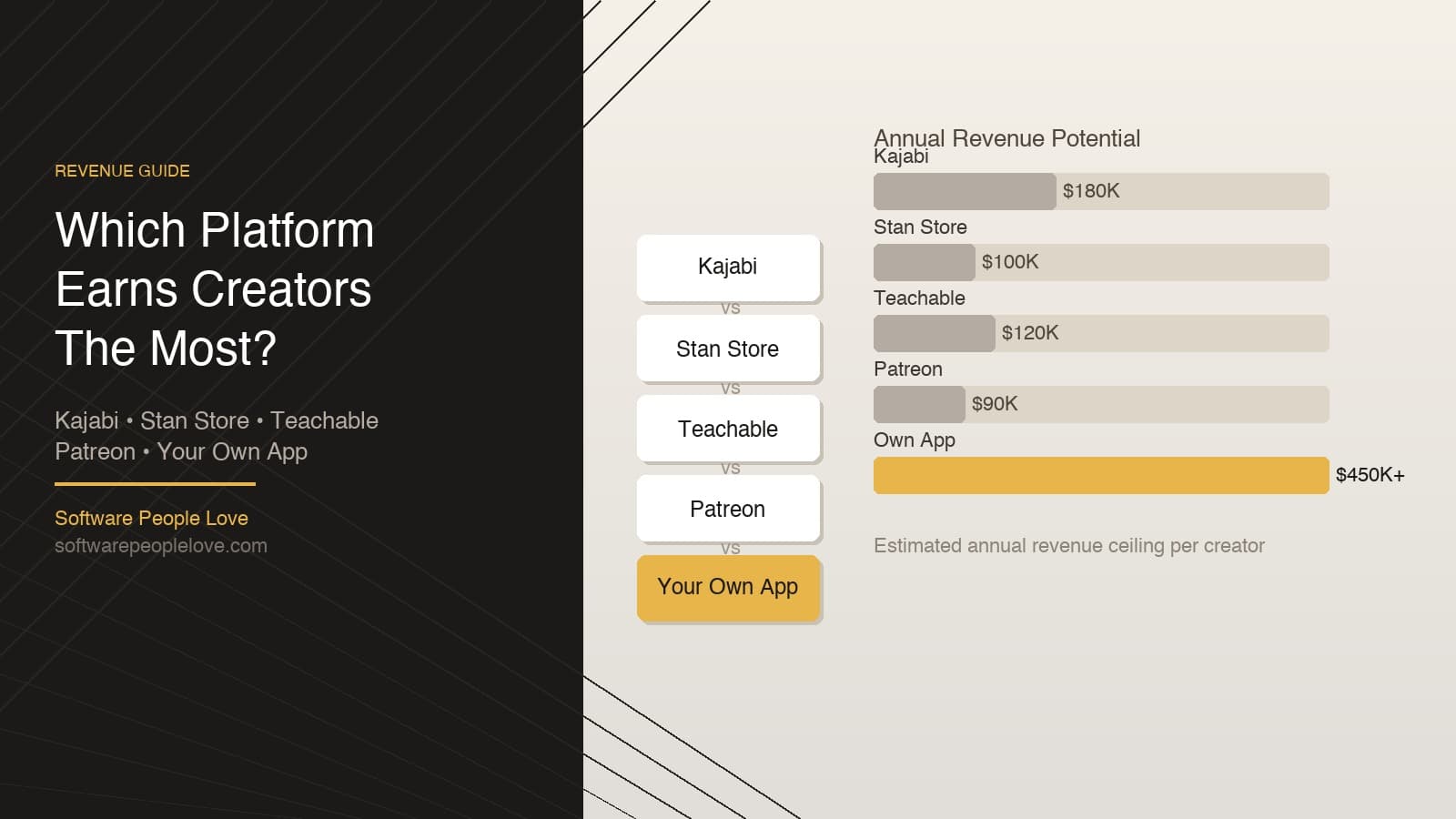
If you're weighing platforms like Kajabi, Stan Store, or Patreon against building your own app, here's the full revenue math on which option earns creators more.
The MVP should include only your core differentiator. If you're a fitness creator, that's the workout programming and tracking. Not the social features, not the marketplace, not the AI coach. Those come in v2, v3, v4.
Ship in weeks, not months. Every week you're not live is a week you're not learning from real users. Health & Fitness apps lead all categories with $0.44 median revenue per install on the App Store (RevenueCat, 2025)—but only if they actually launch.
Step 5: Launch to Your Existing Audience First
Your biggest advantage over every VC-funded startup is your audience. Use it.
The launch sequence that works for creator apps:
Week 1-2 (Pre-launch): Tease the app on your main channels. Show behind-the-scenes content—wireframes, feature previews, your excitement. Ask your audience what they want to see. This builds anticipation and gives you last-minute feedback.
Week 3 (Soft launch): Release to your waitlist and email subscribers first. These are your most engaged followers. They'll find the bugs, leave the first reviews, and give you honest feedback. Aim for 100-500 users in this phase.
Week 4+ (Full launch): Push the app across all channels. Create content specifically about the app—not ads, but genuine content showing how you use it, how users are getting results, and why you built it. Pin posts. Update your bio links. Mention it naturally in your regular content.
How many subscribers do you need to make real money? You need fewer than you think. At $9.99/month, 500 subscribers gets you to $4,995/month. At $29.99/month, just 334 subscribers hits $10K MRR. The math works because subscriptions compound—every new subscriber adds to last month's base.
Ready to go from content to product?
We build custom subscription apps for creators—3-week delivery, $0 upfront, and we handle the tech forever.Let's talk about your app →
Step 6: Retain, Iterate, Grow
Getting subscribers is step one. Keeping them is the whole game.
The subscription apps that win long-term do three things:
Ship updates every 2 weeks. Users need to feel like the app is alive. New workouts, new features, bug fixes, quality-of-life improvements. Apps that go quiet lose subscribers fast.
Build habits, not just features. Push notifications, streaks, reminders, progress tracking—these aren't gimmicks. They're the difference between an app someone opens daily and one they forget about. The first 30 days are critical. Mobile apps with push notifications and in-app accountability features show 45% higher completion rates (GoodBarber, 2026).
Listen to your paying users. Not your free followers—your paying subscribers. They're the ones whose opinions matter most. Build what they ask for. Fix what they complain about. Thank them when they stick around.
The best creator apps grow because the product improves, not because the marketing gets louder. Word-of-mouth from happy subscribers is worth more than any paid ad campaign.
Here's what this framework looks like on a calendar:
| Weeks | Action | Outcome |
|---|
| 1-2 | Identify your product gap (Step 1) | Clear app concept |
| 2-3 | Choose revenue model + validate (Steps 2-3) | Pricing set, demand confirmed |
| 3-6 | Build MVP with a product partner (Step 4) | Working app in App Store |
| 6-8 | Soft launch to waitlist (Step 5) | First 100-500 subscribers |
| 8-12 | Full launch + retention loops (Steps 5-6) | Growth trajectory established |
Three months. That's the gap between "I'm a creator" and "I'm a creator with a product business." Creators with 7+ revenue streams earn $150,000+ annually, while those with only 2 streams stay under $100,000 (DemandSage, 2026). A subscription app is the highest-leverage revenue stream you can add.
Frequently Asked Questions
How much does it cost to build a subscription app?
Custom app development ranges from $25,000-$150,000 depending on complexity. But revenue-share models (like ours) let creators launch for $0 upfront—the development partner earns when you earn. No-code platforms cost $50-200/month but limit what you can build.
Do I need a huge following to make a subscription app work?
No. You need an engaged following—even 10,000-50,000 followers works if they trust your expertise. A 1-2% conversion rate on 50,000 followers gives you 500-1,000 subscribers. At $9.99/month, that's $5K-$10K in monthly recurring revenue.
What types of creators do best with subscription apps?
Creators who teach a skill or provide ongoing value: fitness trainers, nutritionists, language teachers, financial advisors, skincare experts, music instructors. If your audience needs regular guidance (not just one-time answers), a subscription app fits.
How long before a subscription app becomes profitable?
Most creator apps reach profitability within 3-6 months if properly validated and launched. The initial subscriber base from your audience provides revenue from day one. Break-even depends on your cost structure—revenue-share models reach profitability faster since there's no upfront investment to recoup.
What's the biggest mistake creators make with subscription apps?
Building too much before launching. The top-performing apps start simple and add features based on user feedback. Ship your MVP in 3-6 weeks, get real users, then iterate. The second biggest mistake: ignoring retention. Acquiring a new subscriber costs 5-7x more than keeping an existing one.
Ready to turn your expertise into a subscription app? We build custom apps for creators—$0 upfront, 3-week delivery, we handle all the tech forever.
Book Your Free Strategy Call →