Software People Love
Kajabi vs Stan Store vs Your Own App: Which Earns More?

Kajabi vs Stan Store vs Your Own App: Which Earns More?

Software People Love
February 28, 2026
Key Takeaways:
  • Platform fees are just the start — the bigger question is who owns your customers when it's over
  • Kajabi and Stan Store are great tools for getting started but they're rentals, not ownership
  • Patreon takes 5–12% of every dollar you earn, every month, forever
  • A custom mobile app puts your brand on the home screens of App Store and Google Play users worldwide
  • Creators who own their apps build equity; creators who rent platforms build dependency
Every creator hits the same crossroads. You have an audience. Brand deals feel like trading your reach for a one-time check. You want recurring revenue. So you Google your options and land in platform hell. Kajabi. Stan Store. Teachable. Patreon. Gumroad. They all promise recurring revenue. They all have different pricing. They all have slick landing pages full of creator success stories. And none of them tell you what actually happens to your business when you want to leave. This is the breakdown you haven't seen. Not just which platform charges less — but which one actually positions you to build something that compounds. Before we go deep on each platform, here's the honest summary:
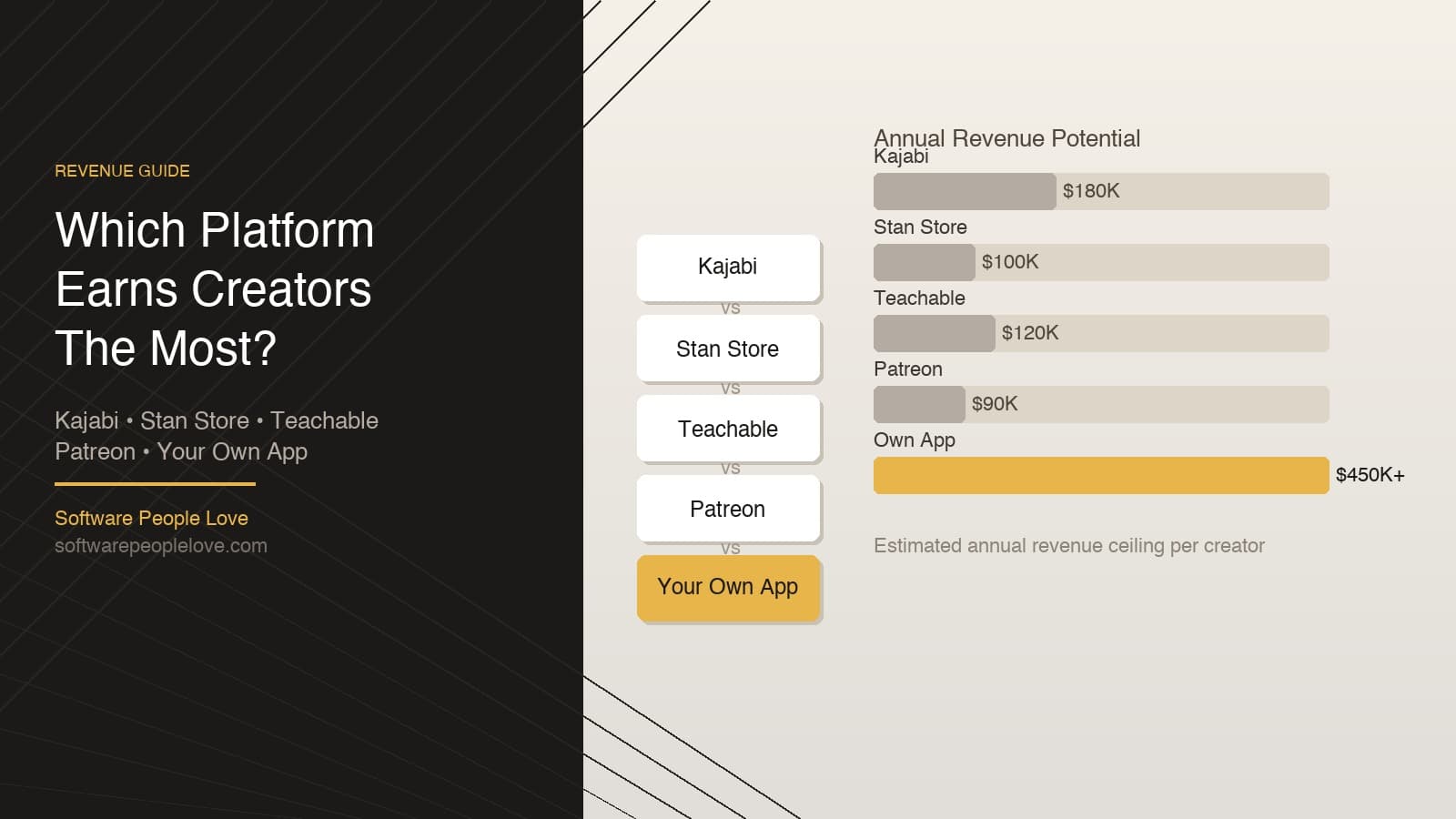
PlatformMonthly CostRevenue CutBranded Mobile App?Who Owns the Audience?
Kajabi$149–$399/mo0% (+ processing)NoKajabi
Stan Store$29–$99/mo0% (+ processing)NoStan Store
Teachable$39–$199/mo0–5% (+ processing)NoTeachable
PatreonFree–$25/mo5–12% (+ processing)Their brandPatreon
GumroadFree10% (+ processing)NoGumroad
Custom App$0 upfrontRevenue share*Yes — YOUR brandYou
*Custom app revenue share varies. At Software People Love, we operate on a revenue-share model with no upfront cost. The "who owns the audience" column is the one most creators ignore — until they can't. Kajabi is the premium choice in creator platforms. At $149–$399 per month, it's the most expensive option — but it offers the most complete toolkit: courses, communities, email marketing, landing pages, payment processing, and a website builder, all under one roof. What Kajabi does well:
  • Zero revenue share on any plan (you keep 100% of sales, minus payment processing)
  • Strong email marketing built in (no need for ConvertKit or Mailchimp)
  • Solid community features for course-based businesses
  • Clean analytics dashboard
Where Kajabi falls short: The monthly fee is real. At $199/month (Business plan), you're paying $2,388 per year before you sell a single thing. For a creator just starting out, that's a meaningful hurdle. More importantly: Kajabi doesn't put you in the App Store. Your members access their content through kajabi.com or Kajabi's generic mobile app — not a branded app with your name on it. For creators building a fitness program, a productivity system, or any experience that benefits from a dedicated mobile interface, this is a meaningful limitation. And if you decide to leave Kajabi? Exporting your subscriber list is possible, but you're rebuilding your entire tech stack from scratch. Best for: Established educators and coaches with proven course revenue ($5K+/month) who want an all-in-one web platform. Stan Store became the go-to link-in-bio solution for creators who want to sell without the complexity of Kajabi. At $29–$99/month, it's accessible. Setup takes hours, not weeks. And the zero revenue share means you keep every dollar you earn. What Stan Store does well:
  • Genuinely the fastest way to start selling digital products
  • Clean, mobile-optimized storefront that works from your Instagram or TikTok bio
  • Handles courses, coaching, digital downloads, and community memberships
  • Zero commission on sales
Where Stan Store falls short: Stan Store is a tool, not a destination. Your customers visit stan.store/yourname — not an app they downloaded for you specifically. There's no App Store listing. No push notifications. No dedicated brand experience. At scale, this matters. The difference between a creator whose members use a generic creator marketplace and a creator whose members have downloaded your branded app is the difference between a customer relationship and a vendor relationship.
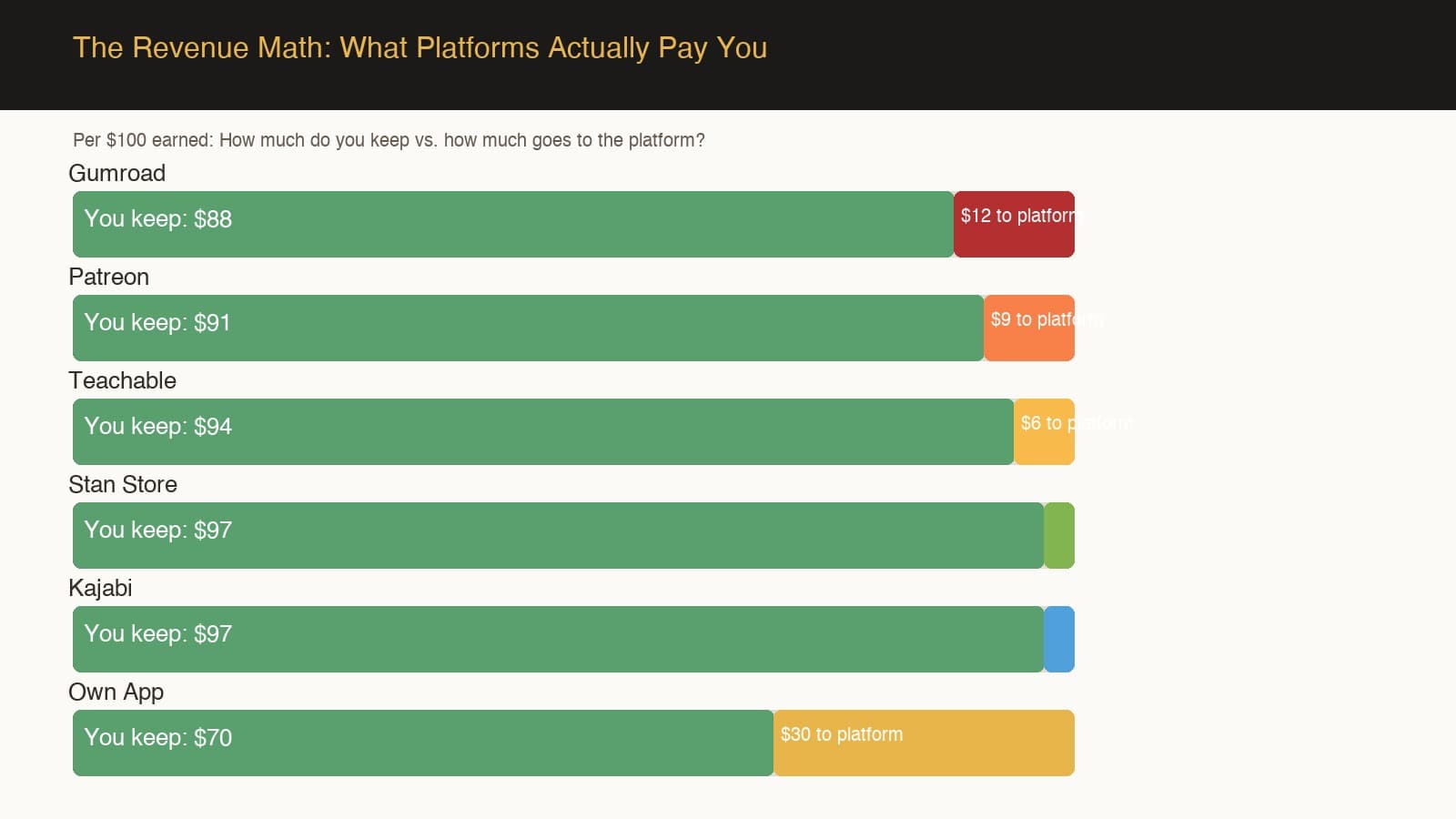
Revenue split comparison across major creator platforms
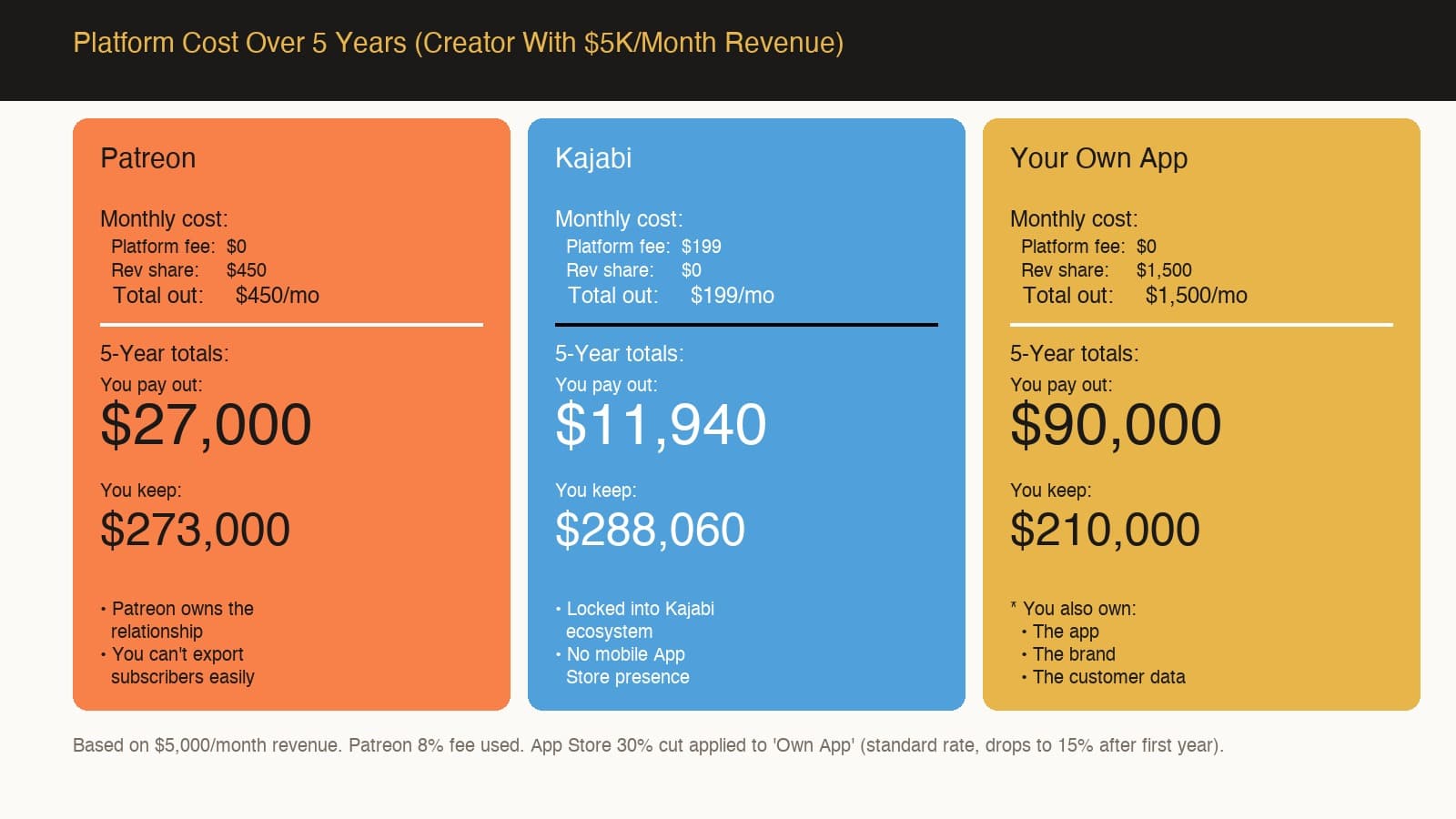
Best for: Creators in early monetization mode who need a simple digital storefront fast. Teachable sits in the middle: more affordable than Kajabi, more course-focused than Stan Store. The Basic plan at $39/month takes a 5% revenue share on top of payment processing — something many creators overlook when they see the low monthly price. The Pro plan at $119/month drops the revenue share to 0% and unlocks more features. For a course-based creator doing $5K/month in revenue, the 5% fee on the Basic plan costs $250/month — more than the Pro plan itself. The math usually pushes you up to Pro. Best for: Course creators who specifically want a learning management system and don't need a community or email marketing platform. Patreon is the original creator subscription platform, and it still has the largest creator community of any platform on this list. The pricing structure looks attractive: free to start. But Patreon's fee model is one of the least favorable for creators at scale. Patreon charges between 5–12% of your monthly earnings depending on your plan (Creator: 8%, Pro: 6%, Premium: 5%), plus payment processing fees of approximately 2.9% + $0.30 per transaction. At $5,000 per month in patron revenue, you're sending $400–$600 to Patreon and Stripe before you touch a dollar. That compounds painfully over time. $500/month in fees is $6,000/year. Over five years, $30,000 — just in platform fees, not counting payment processing.
What is MRR? Monthly Recurring Revenue (MRR) is the predictable, repeating revenue a subscription business generates each month. Unlike one-time sales, MRR compounds as subscribers grow. A creator with 500 members at $10/month has $5,000 MRR — and that number grows every month they retain existing members and add new ones.
There's also a structural problem: Patreon members discover you on Patreon. Their relationship is with the platform, not exclusively with you. If Patreon's algorithm changes, their fees increase, or the platform declines, you feel it directly. That's why your audience is an asset — only if you treat it like one. Best for: Creators focused on exclusive content and community who want to start with zero upfront commitment and are comfortable with the platform fee structure. This is where the comparison gets more interesting — and where most creators don't think far enough ahead. A custom mobile app means your brand is in the App Store and Google Play. Your members search for your name, find YOUR app, download it, and have your brand on their home screen. Apple and Google deliver you new subscribers through App Store optimization. You send push notifications directly to members' phones. You own the customer data. The App Store and Google Play collectively reach more than 2 billion active device users. Kajabi, Stan Store, and Patreon don't exist there for your brand. The cost structure is also different from what people assume. Apple and Google take 30% of in-app subscription revenue (dropping to 15% after the first year of each subscriber's relationship). This is the "platform tax" of the app economy — but you're paying it to reach the world's largest software distribution network, not to a creator tools company that competes for your customers' attention. Compare that to Patreon: you pay 8-12% of revenue to a platform that doesn't put your brand anywhere new. You're paying for infrastructure you could own.
5-year cost comparison across Patreon, Kajabi, and a custom app
Creators who've made this jump include Kayla Itsines, who built the Sweat app and sold it for $400 million, and Jeff Nippard, who became a co-owner of MacroFactor — a nutrition app generating an estimated $30M per year. Neither of those outcomes was available on Kajabi. The honest answer depends on where you are in your creator journey. At $0–$2K/month revenue: Stan Store wins on simplicity and cost. The free tools that come with it (link-in-bio, digital product pages, basic community) let you validate your offer before committing to infrastructure. The 6-step path from content to subscription product starts here. At $2K–$10K/month revenue: Kajabi or a custom app are both worth evaluating. Kajabi gives you the all-in-one suite. A custom app gives you a branded mobile presence and audience ownership. If your content is primarily educational and course-based, Kajabi's ecosystem is hard to beat. If your content is daily, interactive, or experiential — fitness, meditation, music practice, language learning — a mobile app delivers significantly better retention because the experience matches where your members already spend time. At $10K+/month revenue: The math increasingly favors a custom app. At $15,000/month on Patreon, you're paying $1,200–$1,800 per month to Patreon and payment processors. That's $14,400–$21,600 per year — enough to justify building something you own. What the creator middle class earning $10K–$50K per month has learned is that the platform that got you here isn't necessarily the one that takes you further. The deeper consideration isn't fee percentage — it's equity. Brand deals and platform income are income. A subscription app you own is an asset. Ali Abdaal's $10M creator business was built by layering owned products on top of content. Kajabi gets you income. A branded app gets you equity. Not every creator is ready for a custom app. And not every creator should be on Patreon. Here's the honest breakdown: Start with Stan Store if: You're still validating your offer, your audience is under 10K, and you need revenue before you need infrastructure. Move to Kajabi if: You're building a course-based business, you want marketing automation built in, and you're doing consistent $5K+/month. Kajabi's ecosystem is genuinely excellent for this use case. Consider a custom app if: Your content is daily or habitual (workouts, meditations, practice sessions, study tools), your audience is engaged and ready to pay for a premium experience, and you're thinking about the next five years — not just the next five months. See what to look for in a creator app development partner before you start conversations. Avoid Patreon if: You're growing fast. The fee structure that feels fine at $500/month becomes painful at $5,000/month and actively costly at $15,000/month. The question isn't just "which platform is cheapest." The question is: in five years, will you own something? Or will you still be renting?
Is Kajabi worth it for a creator just starting out? Probably not at the $199+/month tier. Kajabi makes sense when you have a validated offer and consistent revenue ($5K+/month) and want to consolidate your tools. Starting creators get better ROI from Stan Store or Gumroad until they've proven their offer works. Can I use Patreon and build my own app at the same time? Yes — and many creators do exactly this during the transition. Patreon becomes the legacy community while the app becomes the primary product. The risk is confusing your audience with two separate subscription products. Plan the migration carefully. What does a custom creator app actually cost? The traditional development route costs $50K–$200K upfront. Software People Love uses a different model: $0 upfront, revenue share after launch. We build, ship, and maintain the app in exchange for a percentage of subscription revenue. Learn more about how we work on our about page. Which platform is best for fitness creators specifically? Fitness creators have the clearest case for a custom app. Your content is daily, habitual, and benefits enormously from mobile-native features: push notification reminders, Apple Health/Google Fit integration, offline access, and a branded home screen presence. Kajabi and Stan Store serve fitness creators at the content-selling stage. A branded app serves them at the business-building stage. The fitness creators who've built the biggest businesses — Kayla Itsines, Whitney Simmons, Krissy Cela — all built apps. Do I need a big audience to justify building my own app? No. A 50K engaged audience can fully support a subscription app business. Audience size matters less than engagement rate and willingness to pay. Why 50K engaged followers beats 5M passive ones covers this math in detail.
The bottom line: Every platform on this list can generate revenue. Only one of them builds an asset. If you're serious about building a business beyond brand deals and content income, the platform question isn't which tool costs least — it's which path gets you to ownership.
Talk to us about building your creator app →