Key Takeaways:
- Most app developers build software, not products—there's a big difference for creators
- A dev partner who doesn't understand creator monetization will cost you 2-3x more in revisions
- The right partner handles App Store submission, payment integration, and ongoing updates—not just code
- Red flags: no creator portfolio, won't discuss revenue models, charges hourly only
- Revenue share models align incentives—your partner wins when you win
You have an audience. You have an idea for an app. Maybe it's a workout tracker, a recipe organizer, a daily habit system—something your followers ask for constantly. You've validated the demand. Now you need someone to build it.
Here's where most creators make an expensive mistake. They hire a developer, not a product partner.
A developer writes code. A product partner builds something people pay for—and keeps it working after launch. That gap is measured in thousands of dollars and months of wasted time.
This guide covers exactly what to look for when choosing someone to build your creator app, and what red flags will cost you dearly.
What Is a Creator App Development Partner?
A creator app development partner is a team or individual who handles all technical aspects of building, launching, and maintaining a mobile app for content creators. Unlike a generic development agency, they understand the creator economy—subscription models, App Store optimization, audience ownership, and the product decisions that drive recurring revenue.
The distinction matters. A general developer can build you an app. A creator-focused partner builds you a business.
Why Most Developers Aren't the Right Fit for Creators
Standard software development firms serve enterprise clients: banks, hospitals, SaaS companies with technical co-founders and in-house product teams. Those clients can write detailed specifications, manage developers directly, and handle product decisions internally.
Creators don't have that. They have expertise in their niche, an audience that trusts them, and a vision—but usually no technical background. The development partner has to fill that gap.
A 2025 Deloitte study found that 68% of creator-led digital product launches fail within the first year. The most common reason: misaligned incentives between creators and their technical partners.
When a developer charges by the hour, their incentive is more hours. When they charge by project, their incentive is done quickly, not done well. Neither model aligns with what you actually need: an app that earns recurring revenue long-term.
Tired of generic dev quotes that ignore your audience?
We build apps specifically for creators—$0 upfront, revenue share model, and we handle everything forever.Book a free strategy call →
1. A Portfolio of Creator-Specific Apps
The single fastest way to filter partners: ask to see apps they've built for content creators. Not just apps—creator apps. Things that have subscribers, premium tiers, and real user reviews.
A fitness app built for a brand is different from a fitness app built for a YouTuber with 800K followers. The latter has to handle audience expectations, creator-branded UX, content delivery schedules, and subscription pricing that matches what the creator's audience is willing to pay.
What to ask:
- "Show me 3 apps you've built for content creators."
- "What was the monthly active user count 6 months post-launch?"
- "How many subscribers did the app reach in year one?"
If they can't answer those questions, they've built demos, not businesses.
2. They Think in Revenue Models, Not Features
The wrong conversation sounds like this: "We'll build your workout app with video support, a calendar, and a profile page—$45,000."
The right conversation sounds like this: "Who is your most engaged subscriber? What would they pay $15/month for? How many of them exist in your audience? Let's build the minimum version that converts them first."
A creator app partner leads with business outcomes—subscribers, monthly recurring revenue, retention rate—not feature lists. Features are how you get there. Revenue is why you're building it.
What separates product thinking from developer thinking:
| Developer Thinking | Product Partner Thinking |
|---|
| "What features do you want?" | "What outcome does your audience pay for?" |
| "We'll need 6 months to build this" | "What's the smallest version that earns revenue?" |
| "That's out of scope" | "That's a V2 decision, here's what to prioritize now" |
| "We'll handle the tech, you handle marketing" | "Let's align the onboarding to your content funnel" |
| "Hourly rate: $150/hr" | "Revenue share: we win when you win" |
3. They Handle the Full Launch Stack
Building the app is step 3 of 10. Most developers only do step 3.
The full launch stack for a creator app includes:
- App Store and Google Play setup and optimization
- Privacy policy and terms of service for your jurisdiction
- In-app purchase implementation (Apple's rules are unforgiving)
- Push notification infrastructure
- Analytics and user tracking setup
- Subscription management and billing
- App Store review management and responding to rejections
- Post-launch bug fixes and OS updates
Nearly 40% of iOS app submissions get rejected on first submission (Apple developer data, 2025). A partner who's never navigated an App Store rejection is going to leave you hanging when it happens to yours.
Ask specifically: "Who handles our App Store submission and what happens if we get rejected?"
4. Ongoing Support Is Included, Not Billed Separately
This one surprises most creators: the work doesn't stop at launch.
Apple releases major iOS updates annually. Android does the same. Each update can break features that worked perfectly before. Payment processors change their APIs. New privacy regulations require app changes. Users find bugs that your QA process missed.
If your development partner bills you hourly for post-launch fixes, you'll spend $500-$2,000 every few months on maintenance you didn't budget for. Over 2 years, that's a significant unexpected cost.
The best creator app partners build ongoing maintenance into their model. Either through a monthly retainer, a revenue share that keeps them invested in your app's success, or a clear SLA that guarantees bug fixes and OS updates at no extra charge.
Ask: "What does ongoing support look like after launch? What does it cost?"
5. They've Navigated Real Subscription Monetization
Subscription apps have specific technical and business requirements that most developers have never encountered. Not in a theoretical sense—in a "we've dealt with Apple rejecting our in-app purchase implementation three times" sense.
Real subscription experience looks like:
- Building trial-to-paid conversion flows that actually convert
- Handling subscription cancellations and win-back sequences
- Implementing annual vs monthly pricing tests
- Managing refund requests and subscription pauses
- Integrating with RevenueCat, Stripe, or similar for cross-platform consistency
Whitney Simmons launched the Alive app and reached 30,000+ five-star reviews. Kayla Itsines scaled Sweat to 450,000 paying subscribers before selling for $400M. Both had partners who understood subscription mechanics deeply.
Ask: "Show me an example of a paywall you've built and the conversion rate it achieved."
6. They Ask About Your Audience Before Your App Idea
This sounds counterintuitive, but the best development partners spend more time asking about your audience than your feature list.
They want to know:
- What platform are your followers most engaged on?
- What do they already pay you for (merchandise, courses, memberships)?
- What's the average age and income bracket?
- How do they consume content—video, text, audio?
- What problem do they tell you about most in comments and DMs?
The answers shape every product decision: pricing, core features, onboarding flow, notification strategy, and platform choice (iOS-first vs Android-first vs cross-platform).
A partner who jumps straight to "here's what we'll build" without understanding your audience will build the wrong thing. It will look right, but it won't convert.
7. Incentives Are Aligned With Your Success
This is the big one. The most common development model—hourly billing or fixed project fee—creates misaligned incentives.
Hourly billing: the developer benefits from the project taking longer. Every scope change, every revision, every bug fix is more money for them. Your incentive is to ship fast; theirs is to bill more.
Fixed project fee: the developer benefits from cutting corners to hit the deadline. Quality suffers when budget gets tight.
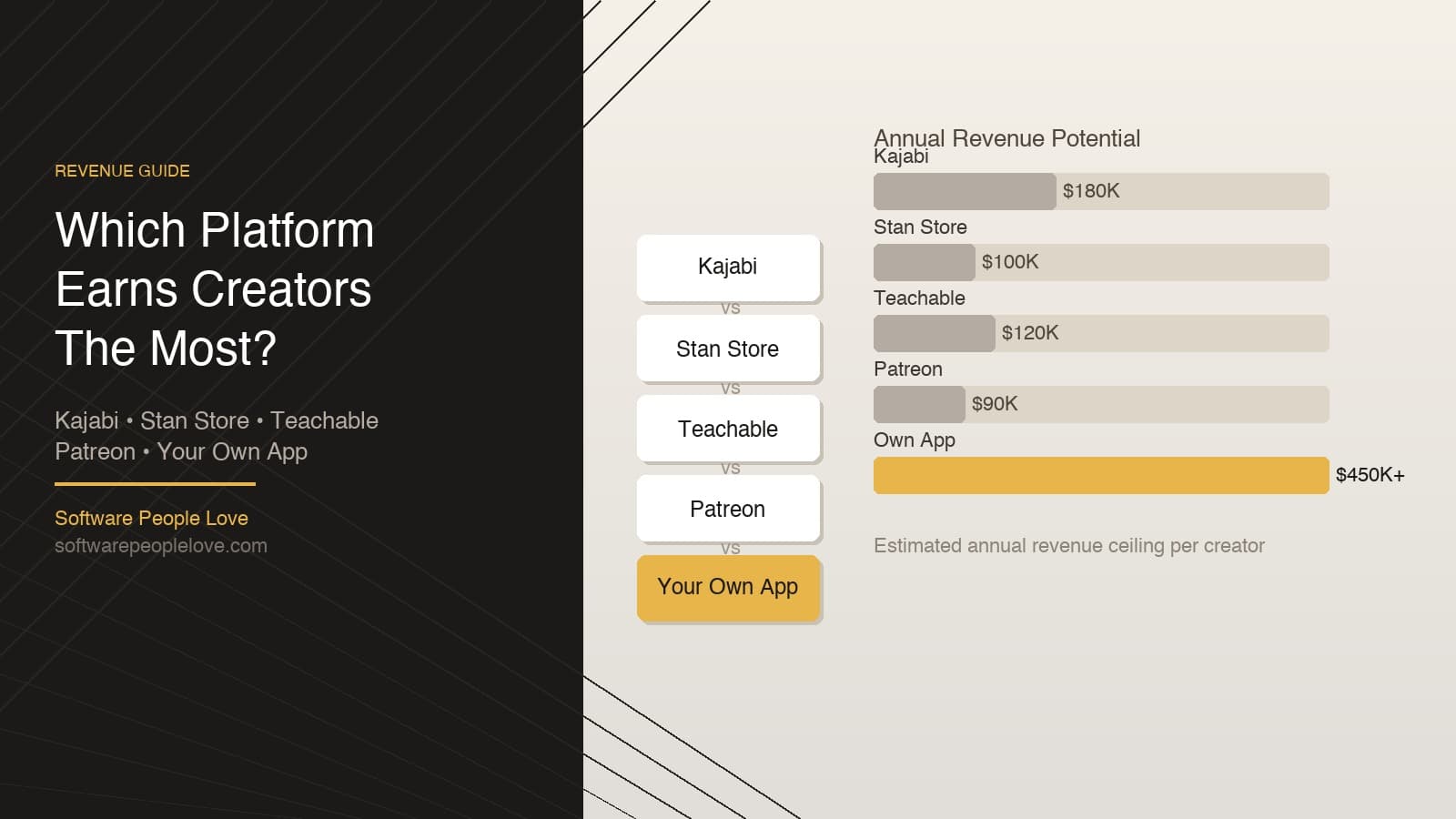
Revenue share aligns incentives completely. If your app earns, your partner earns. If you launch and nobody subscribes, they don't get paid. That's a partner who's invested in your success the same way you are.
It's also how Software People Love works: $0 upfront, we build your app, and we take a percentage of subscription revenue. We only win when you win.
Want a partner who wins when you win?
Revenue share model means $0 upfront—we only earn when your app earns. 3-week delivery, we handle all the tech forever.See if you qualify →
3 Red Flags That Will Cost You
Red Flag 1: "We'll need your full requirements document first."
Any serious creator app partner can scope and advise based on a conversation. If they can't tell you roughly what you need, what it costs, and how long it takes from a 30-minute call—they don't know creator apps well enough.
Real product partners lead the conversation. They've built similar things before and can estimate quickly.
Red Flag 2: No examples of creator apps in their portfolio.
Generic development experience doesn't transfer well to creator apps. The App Store optimization, the subscription UX, the creator-audience relationship built into the product design—these require specific knowledge.
If the portfolio is all SaaS tools, enterprise dashboards, and e-commerce sites, they'll apply those patterns to your creator app. It won't feel right to your audience.
Red Flag 3: They won't quote a fixed outcome.
"We'll build you an app" is not a deliverable. "We'll build a subscription iOS app with payment integration, push notifications, onboarding flow, and App Store submission within 10 weeks" is.
Vague deliverables mean scope creep, budget overruns, and a launch date that keeps moving. Get specific commitments in writing before signing anything.
Before you commit to any development partner, run through this checklist:
- Portfolio review — See 3 creator apps they've shipped with user metrics
- Audience-first conversation — They ask more about your audience than your features
- Scope and timeline — Specific deliverables, not vague estimates
- Post-launch model — Clear plan for maintenance, updates, and App Store issues
- Revenue alignment — How do their incentives match yours?
- Subscription experience — Specific examples of paywall design and conversion rates
- References — Talk to a previous creator client, not just read a testimonial
This might feel like a lot. But you're about to spend significant time, money, and audience trust on this product. A 2-hour due diligence process saves you from a 6-month mistake.
What the Right Partner Looks Like in Practice
The right creator app partner doesn't wait for you to come to them with a spec sheet. They help you figure out what to build before a line of code gets written.
They ask about your audience. They model out revenue scenarios based on what your followers actually pay for. They flag when an idea is too complex for V1 and suggest what to cut. They know App Store guidelines well enough to build compliance in from day one, not fix it at submission.
And after launch, they're still there. When iOS 20 breaks your push notifications, they fix it. When your subscription churn spikes, they audit the offboarding flow and rebuild it. When you want to add a new feature, they scope it quickly and tell you whether it's worth it.
That's not a developer. That's a product partner.
Frequently Asked Questions
How much does it cost to build a creator app?
Creator apps typically cost between $15,000-$75,000 when working with a fixed-fee development firm. Revenue share models (like Software People Love uses) require $0 upfront—the development partner earns a percentage of subscription revenue instead. Complex apps with custom AI features or multi-platform builds cost more, but most creator apps don't need that complexity in V1.
How long does it take to build a creator app?
A focused MVP creator app takes 6-12 weeks from kickoff to App Store submission. More complex apps with custom backend systems take 3-6 months. Be skeptical of any partner quoting less than 6 weeks for a production-ready subscription app—those timelines usually mean cutting corners.
Should I build for iOS or Android first?
For most creators in North America and Europe, iOS-first is the right call. iPhone users spend 2.5x more on apps than Android users, and iOS subscription conversion rates are consistently higher. Build for iOS, launch, validate the revenue model, then expand to Android.
What questions should I ask a developer before hiring them?
Ask to see creator apps they've shipped with user metrics. Ask how they handle App Store rejections. Ask what post-launch support looks like and what it costs. Ask how they approach pricing and subscription design. Ask to speak with a previous creator client. The answers tell you everything you need to know.
Do I need to know how to code to work with a development partner?
No. The right development partner translates between your vision and the technical work. You should understand your audience deeply and have opinions about user experience—but you don't need to write code, review pull requests, or understand database schemas. That's their job.
Ready to build your app with a partner who wins when you win? We build custom apps for creators—$0 upfront, 3-week scoping, and we handle all the technical work forever.
Book Your Free Strategy Call →