Key Takeaways:
- Only 4% of creators earn over $100K/year, while 50% earn less than $15K — but a growing "middle class" is closing the gap with subscription revenue
- Creators with 50K–200K followers are earning $10K–$50K/month by converting small percentages of their audience into app subscribers
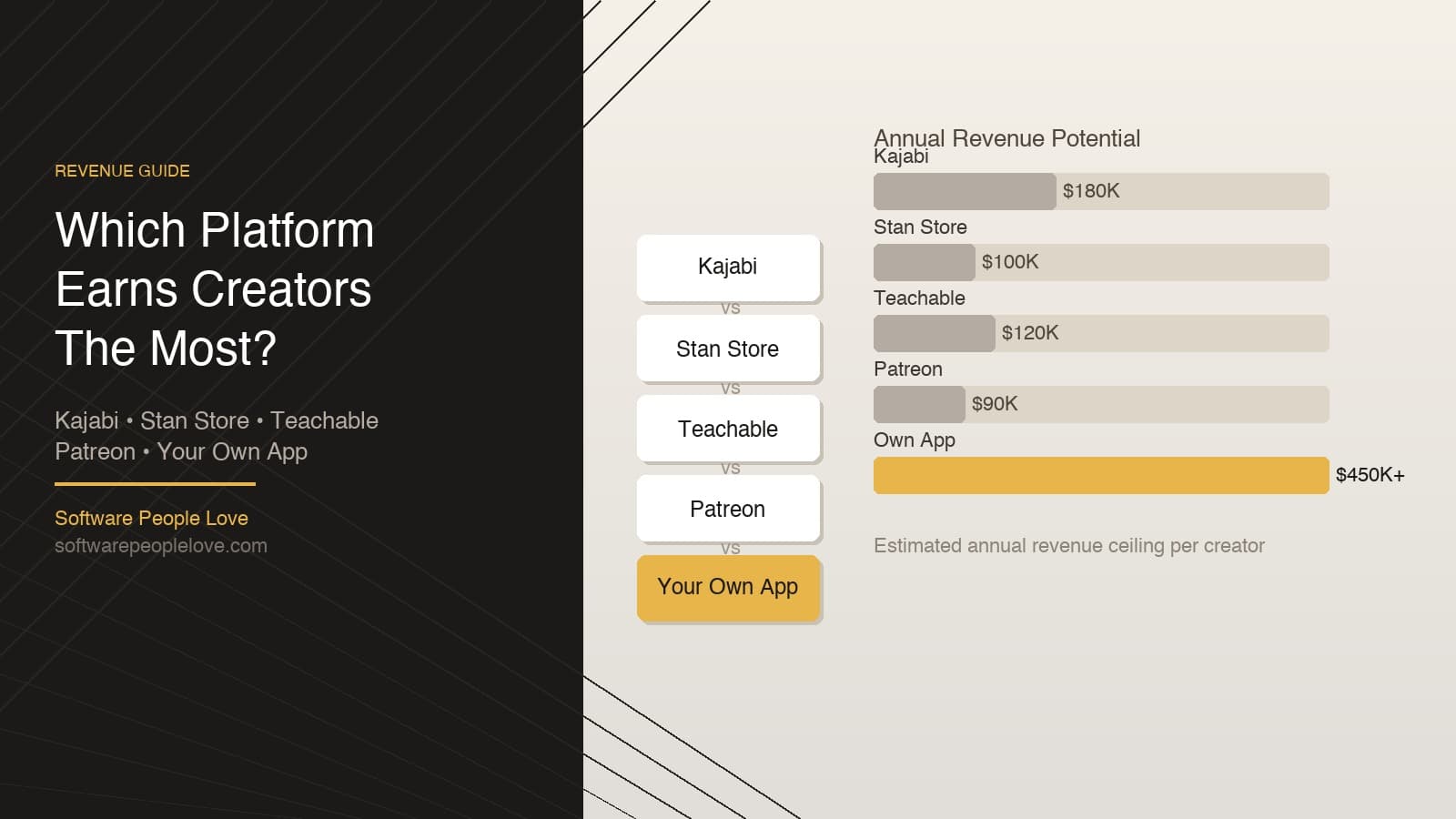
- Subscription-based apps generate 3–5x more lifetime value per customer than one-time digital products
- The creator economy is projected to hit $500 billion by 2027 (Uscreen, 2026), and subscription segments are the fastest-growing revenue channel
- You don't need millions of followers. You need 200–500 paying subscribers at $30–$100/month.
The creator economy has a dirty secret: almost nobody is making real money.
Half of all creators earn less than $15,000 per year (Grand View Research, 2024). The other half mostly scrapes by on inconsistent brand deals, ad revenue that fluctuates with algorithms, and platform payouts worth less than minimum wage.
Then there's a small group — call them the creator middle class — quietly pulling in $10,000 to $50,000 every single month. They're not celebrities. Most of them don't go viral. They don't have 5 million followers.
They have subscription apps.
What Is the Creator Middle Class?
What is the creator middle class? It's the growing tier of creators earning $120K–$600K annually through owned products and subscription revenue, not platform ad payouts or brand deals.
Think of the traditional middle class: people who earn a solid living without being rich or famous. The creator version looks similar. These are people with real expertise, a loyal audience of 50K–300K followers, and a product that generates recurring revenue.
They're fitness coaches who built workout apps — like Chloe Ting, who went from 25M YouTube subscribers to launching the Core app with 660,000+ downloads. Music teachers who turned lesson plans into subscription platforms. Wellness creators who packaged their routines into guided programs you pay for monthly.
The defining trait: they own what they sell. They're not renting their audience to brands for one-time payments. They're not waiting for YouTube's algorithm to decide if they get paid this month.
The numbers paint a stark picture of creator income distribution:
| Income Level | % of Creators | Annual Earnings |
|---|
| Struggling | 50% | Under $15,000 |
| Getting by | 18% | $15,000–$50,000 |
| Middle class | 15% | $50,000–$250,000 |
| Top earners | 8% | $250,000–$1M |
| Elite | 4% | Over $1M |
| Pre-revenue | 5% | $0 |
Source: Circle 2026 Community Trends Report
The "middle class" tier — that 15% earning $50K–$250K — is where things get interesting. These creators have figured out something the bottom 68% haven't: how to build recurring revenue that doesn't depend on going viral or landing the next brand deal.
And the fastest path into that tier? Subscription apps.
Why Subscription Apps Are the Middle-Class Engine
Platform payouts are broken. TikTok pays $0.02–$0.05 per 1,000 views (Uscreen, 2026). You'd need 50 million views per month to make $2,500 from TikTok's creator fund alone. That's not a business — it's a lottery ticket.
Brand deals pay better, but 69% of creators rely on them as their primary income (eMarketer, 2026), which means they're stuck in a cycle of pitching, negotiating, filming sponsored content, and starting over every month.
Subscription apps flip the model. Here's the math:
| Metric | Brand Deals | Platform Payouts | Subscription App |
|---|
| Monthly revenue (50K followers) | $2,000–$5,000 | $200–$800 | $6,000–$50,000 |
| Revenue predictability | None | Low | High |
| Scales without more content? | No | No | Yes |
| Keeps earning while you sleep? | No | Barely | Yes |
| You own the customer relationship? | No | No | Yes |
The subscription app column wins every category. And it's not theoretical — creators are doing it right now.
Want to join the creator middle class?
We help creators turn their expertise into subscription apps — $0 upfront, we handle all the tech.Book a free strategy call →
3 Creators Who Built Middle-Class Businesses
You don't need to be Kayla Itsines (who sold her app for $400M) to make this work. Here are three creators at different scales who built sustainable subscription income:
1. Katja — $8,000+/Month from Pilates & Yoga
Katja runs a pilates and yoga membership through her own app. She doesn't have millions of followers. She has a focused niche, quality content, and a subscription model that generates over $8,000 in monthly recurring revenue (Uscreen, 2026).
Her secret isn't virality. It's consistency and a product people use daily.
2. Prodigies — $40,000+/Month from Music Education
Prodigies, a music education platform, earns over $40,000 monthly by combining membership subscriptions with digital product sales and interactive content. They turned music lessons into a subscription service that parents pay for every month (Uscreen, 2026).
No viral videos required. Just structured knowledge delivered through a product people value.
3. Abundance+ — $100,000+/Month from Wellness Content
Abundance+ crossed $100K in monthly revenue through recurring memberships built on its own platform (Uscreen, 2026). They package mindfulness, spiritual growth, and wellness content into a subscription that thousands of people pay for automatically every month.
The pattern is clear: expertise + subscription model + owned platform = predictable income.
The Math: How Many Subscribers Do You Actually Need?
This is the part that surprises most creators. You don't need thousands of subscribers to hit middle-class income. Run the numbers:
| Monthly Revenue Goal | At $19.99/month | At $29.99/month | At $49.99/month | At $99.99/month |
|---|
| $10,000 | 501 subs | 334 subs | 201 subs | 101 subs |
| $20,000 | 1,001 subs | 668 subs | 401 subs | 201 subs |
| $30,000 | 1,501 subs | 1,001 subs | 601 subs | 301 subs |
| $50,000 | 2,502 subs | 1,668 subs | 1,001 subs | 501 subs |
If you have 100,000 followers, you need 0.3% of your audience to subscribe at $30/month to hit $10K MRR. Three out of every thousand followers.
Most email lists convert at 2–5% for purchases. Social media follows convert lower, but even a 0.5% conversion rate on 100K followers gives you 500 subscribers — enough for $15K/month at a $30 price point.
The math works at small scales, too. A creator with 30,000 engaged followers who converts 1% at $50/month makes $15,000/month. That's $180,000/year from 300 customers.
Ready to run the numbers for your audience?
We'll help you figure out the right price point, feature set, and conversion strategy for your niche.Book a free strategy call →
What Separates the Middle Class from the Bottom 68%
After studying creators who've broken into sustainable income versus those stuck below $15K/year, the differences come down to five things:
1. They Sell Recurring Access, Not One-Time Products
Courses, ebooks, and presets are one-time purchases. You sell them, collect the cash, and need to find new buyers next month. Subscription apps charge monthly, and revenue accumulates.
A $50 ebook sold to 200 people makes $10,000 once. A $15/month app with 200 subscribers makes $36,000 per year — and grows as you add subscribers.
88% of successful creators monetize through paid memberships on platforms they control (Circle, 2026). They're not building on rented land like Instagram or TikTok, where an algorithm change can wipe out their reach overnight.
When you own your app, you own your customer list, your payment relationships, and your data. No platform can take that away.
3. They Pick a Niche and Go Deep
The middle-class creator isn't trying to appeal to everyone. Katja teaches pilates. Prodigies teaches music to kids. They're not "lifestyle" or "wellness" creators in a vague sense — they solve a specific problem for a specific person.
Specificity is a superpower when you're selling subscriptions. "Get fit" attracts browsers. "8-week postpartum pilates recovery program" attracts buyers.
Thomas Frank built a $2M Notion template business from one specific niche: productivity systems for students and knowledge workers. He didn't try to serve everyone. He served people who think in Notion.
4. They Treat Content as Marketing, Not Product
Most creators treat content itself as the thing they sell (through ads and brand deals). Middle-class creators treat content as free marketing that drives subscribers to their paid product.
Their TikToks and Instagram posts aren't the business. Those are the funnel. The app is the business.
5. They Build for Retention, Not Virality
Going viral brings in new followers. Retention keeps subscribers paying month after month. Middle-class creators obsess over reducing churn — adding new content regularly, building community features, sending push notifications, and creating reasons to open the app daily.
Apps with strong community features reduce churn by 25–30% compared to content-only apps. That's the difference between keeping 80% of your subscribers each month versus 60%.
How to Get Started (Without Millions of Followers)
You don't need to wait until you're "big enough." Creators are building subscription apps with 30K–50K followers and hitting profitable MRR within months. Here's the playbook:
Step 1: Identify what your audience already pays for. Look at your DMs, comments, and the questions you get asked most. That's your product idea.
Step 2: Validate before building. Survey your audience. Ask 100 followers if they'd pay $X/month for Y. If 10+ say yes, you have a viable concept.
Step 3: Start with a focused MVP. Your first version doesn't need 50 features. It needs the one thing your audience can't get anywhere else — delivered consistently through a subscription.
Step 4: Partner with a product team. You don't need to learn to code or hire a dev shop that doesn't understand creators. You need a partner who understands both product strategy and your audience. (We wrote about this.)
Step 5: Use your existing content as the launch funnel. Every TikTok, Reel, and YouTube video becomes marketing for your app. The content you're already creating drives subscribers.
Frequently Asked Questions
How much does it cost to build a creator subscription app?
Traditional development costs range from $25,000–$150,000. With a revenue-share model like ours, the upfront cost is $0 — you pay nothing until the app earns money. This makes it accessible for creators at any scale.
How long does it take to start earning from a subscription app?
Most creator apps reach their first 100 subscribers within 2–3 months of launch, assuming the creator actively promotes it to their existing audience. Time to $10K/month MRR typically ranges from 4–8 months.
Do I need a huge following to make a subscription app work?
No. Creators with 30,000–50,000 engaged followers can build profitable subscription apps. The key is engagement rate, not follower count. A 50K audience with 5% engagement is worth more than 500K with 0.5% engagement. (We've written about this.)
What types of apps work best for subscription revenue?
Fitness programs, educational content, coaching platforms, and community-based apps perform strongest. Anything where users get ongoing value — not just a one-time download — works well as a subscription.
Can I still do brand deals if I have my own app?
Yes — and most brands actually prefer working with creators who have their own products. It signals you're running a real business, not just posting content. Many middle-class creators use brand deals to supplement their subscription income, not replace it.
The creator economy is worth $250 billion and growing at 26% annually (Uscreen, 2026). But most of that money goes to the top 4%. The creator middle class exists because a small group figured out the subscription math and stopped waiting for algorithms to decide their income.
You don't need 5 million followers. You need 200–500 people willing to pay you every month for something they actually use. That's it.
The gap between "struggling creator" and "$20K/month creator" isn't talent, luck, or follower count. It's business model.
Want to build your own subscription app? We help creators turn expertise into custom apps — $0 upfront, 3-week delivery, we handle all the tech forever.
Book Your Free Strategy Call →